Fewer brands, more brand equity?


A brand portfolio rarely grows according to a predefined plan. Acquisitions bring new names, new activities are launched under separate brands and local brands remain because customers know them. What makes sense one decision at a time can, years later, result in a portfolio that no one can objectively explain.
Even the largest brand owners continually reassess where to place priority within their portfolios. Nestlé went from more than 400 brands receiving media support at the start of 2024 to around 150 in 2026. Unilever had around 400 brands in 2023 and now concentrates its growth strategy on 30 Power Brands, together accounting for around 75% of turnover.
Those figures point to sharper prioritisation within the portfolio. Whether that also results in fewer brands is a different question. First, the role and value behind each name have to be understood.

Research first, structure second
A brand architecture exercise therefore starts by mapping the existing portfolio in full. Which audiences does each brand serve? With what offer and positioning? In which markets? Where do brands overlap, and where do they genuinely complement one another?
Brand equity is part of that assessment. Awareness, associations, perceived quality and loyalty can be strongly built around one specific name. That value does not automatically transfer when a brand disappears.
Only when those elements are assessed together can a company objectively determine which brands genuinely deserve an independent role.
Overlap can make consolidation the logical choice
When two brands largely address the same audience, offer a comparable proposition and carry little brand equity of their own, consolidation can be the stronger choice. Marketing, innovation and reputation are then no longer spread across different names.
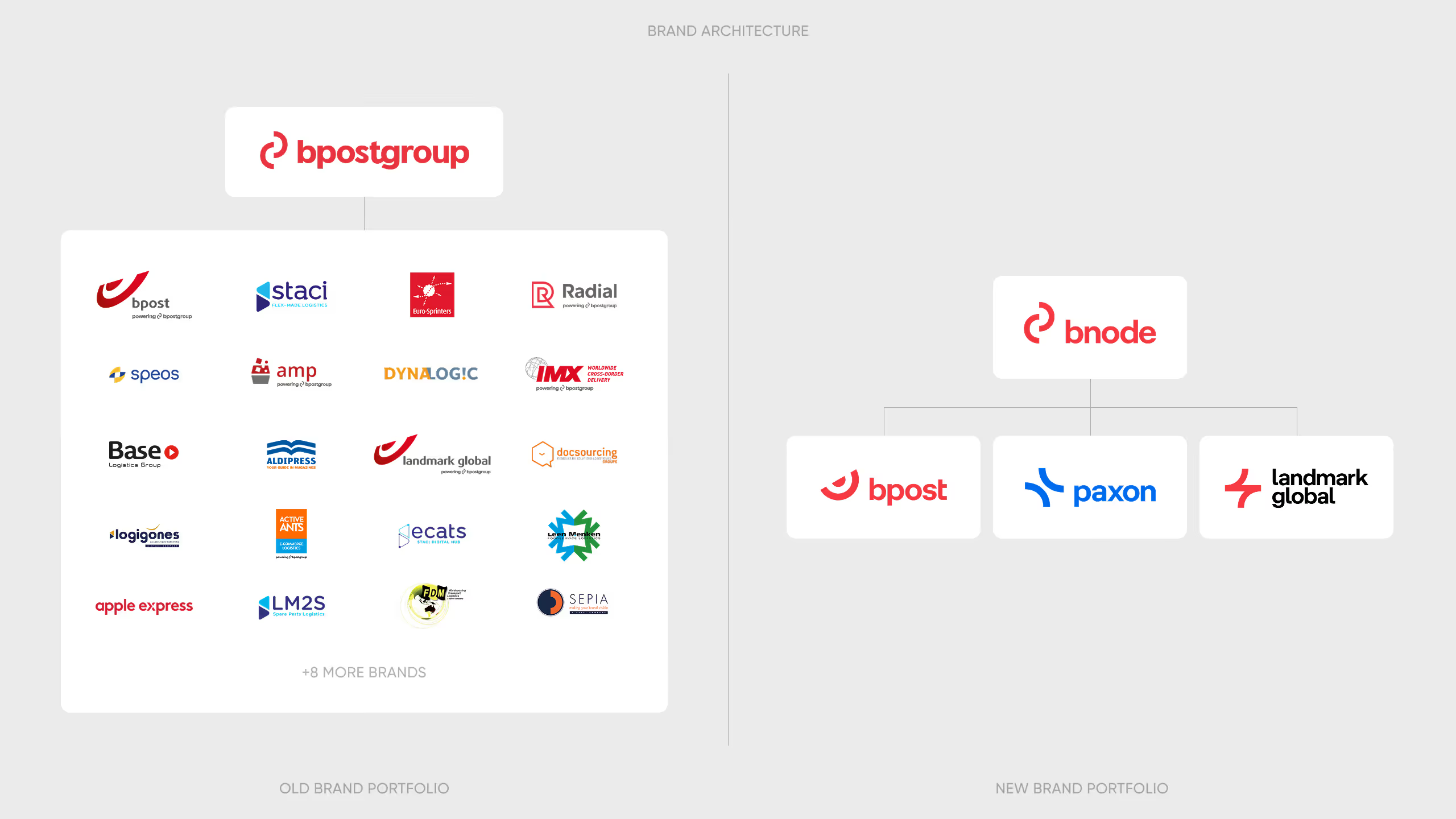
The outcome changes when a brand has built meaning of its own in the market. At bnode, a portfolio of 31 brands was reduced to an architecture of four. Yet bpost remained alongside paxon and Landmark Global, each with a clear commercial role.
The right structure follows from the research. For one brand that means integration, for another retention.
Then look at what the business needs tomorrow
The current situation is only one part of the analysis. Brand architecture must also align with the company’s strategy for the years ahead.
Should activities become more integrated? Is international expansion planned? Does one brand need to accommodate new products or acquisitions? Or does an activity need its own growth path and market position?
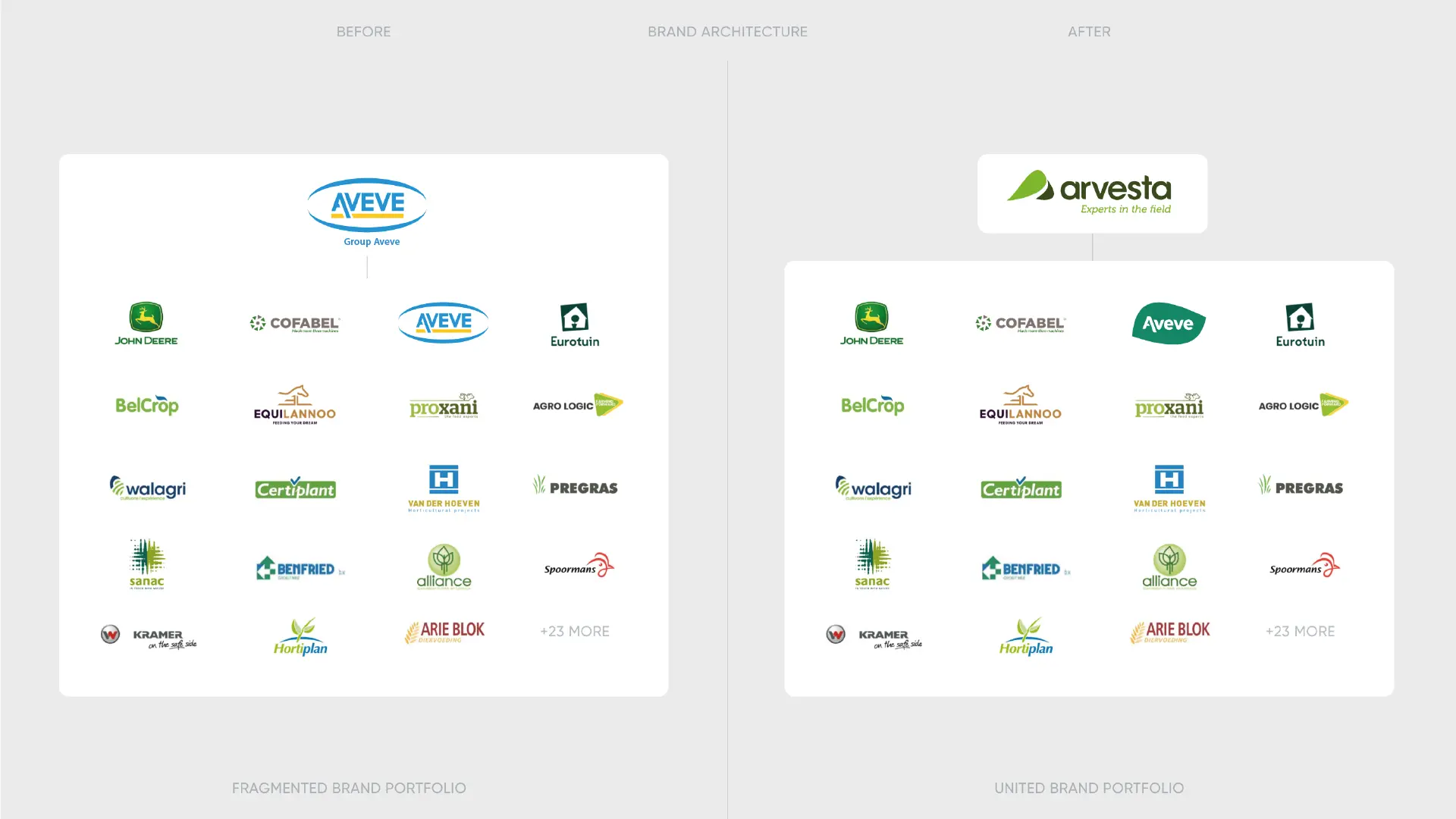
Arvesta shows how that analysis can lead to a different structure. After growth and acquisitions, a new corporate brand was developed above more than 40 existing B2B and B2C brands. This gave the group one clear identity without automatically replacing every commercial brand that had already built value.
Unilever made a different portfolio choice within that broader focus. Its ice cream business was demerged at the end of 2025 as the independent The Magnum Ice Cream Company. Sharper focus can therefore also mean giving an activity greater independence.
Assess whether the name can carry the future
When an existing brand is expected to take on a larger role, the name itself also needs to be assessed. Is it broad enough for new activities? Does it work internationally? Is it sufficiently distinctive and legally available in the markets where the company intends to grow?
That legal brand protection belongs in the analysis before the architecture is finalised. A commercially strong name in one market can be difficult to extend legally into another. Existing trademark registrations also need to cover the activities the brand will be expected to carry in the future.
A brand architecture diagram is therefore the end point of the exercise. Market role, brand equity, future plans and legal possibilities first need to be assessed together. Only then can a company make a grounded decision about which brands should grow, which should remain independent, which can disappear and where a new name or structure is required.