When does a parent brand add value?


Why would a company remove a familiar parent name from its brand? Siemens Healthineers recently announced plans to become Healthineers as part of its proposed separation from Siemens. The change still requires approval, but it illustrates how the role of a parent brand can evolve as a business builds its own position.
Whether the parent brand should be visible depends on the value that connection adds. That value differs across brands, audiences and stages of growth.

When endorsement transfers trust
An established parent brand can help a less familiar brand by transferring recognition, expertise and trust. Making that connection deliberately visible is known as endorsement.
It can take the form of a shared name, an explicit reference to the parent company or recognisable visual cues. The strength of the association varies. A common visual language may suggest a connection, while a phrase such as 'by Marriott' states it explicitly.
Consider Courtyard by Marriott. Courtyard has its own positioning in the hotel market, while potentially benefiting from the recognition of Marriott. For travellers unfamiliar with Courtyard, the Marriott name may create expectations of quality and reliability.
Endorsement can therefore add value when the parent brand carries associations relevant to the intended audience. That familiar endorsement can be especially useful for new activities, international expansion or acquisitions.
But the need for it can change. Siemens Healthineers' planned name change is tied to its proposed separation. From a brand strategy perspective, the question is whether Healthineers has built enough recognition and meaning of its own to move forward without the Siemens name in the foreground.
When the group brand needs more visibility
The opposite approach is visible at Anacura, a Belgian group active in medical diagnostics and life sciences.
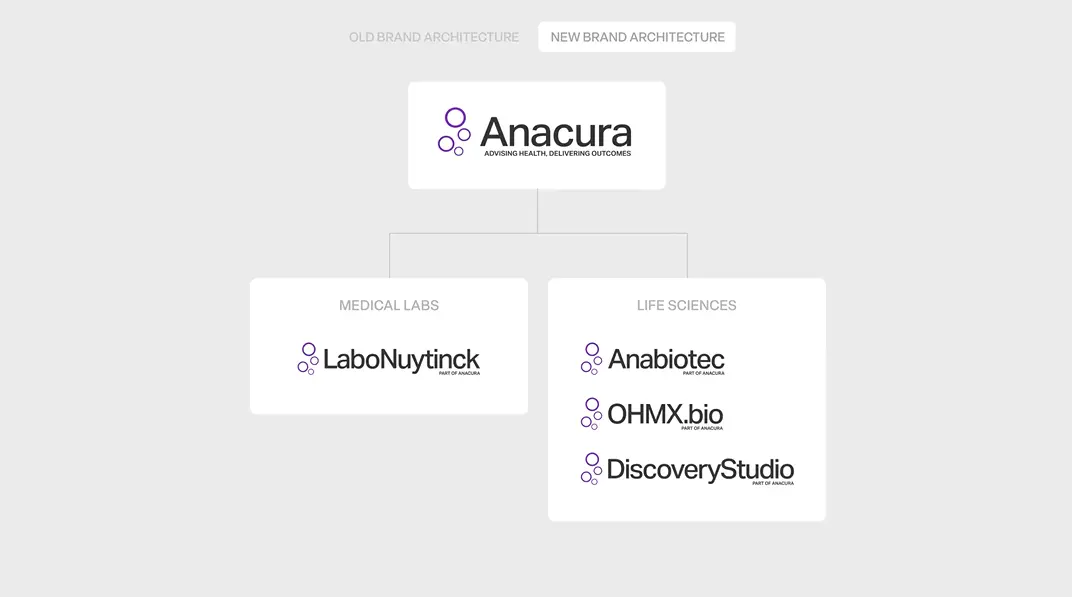
The group includes specialised brands such as Labo Nuytinck, Anabiotec, OHMX.bio and Discovery Studio. In the strategic brand development project with Remarkable Europe, Anacura took on a clearer role as the overarching group brand, with two divisions: Medical Labs and Life Sciences.
The individual brands retain their commercial identities, but are connected through a shared brand architecture. Alongside visual coherence, some entities also state that relationship explicitly through the phrase 'an anacura company'.
That connection serves a strategic purpose. A partner familiar with a single specialist laboratory can recognise the wider scientific expertise and capacity behind it through the group brand.
A more visible group brand can strengthen the meaning of each specialist brand without replacing its own position in the market.

The parent company's reputation travels with the brand
Yet giving brands an independent identity has a clear limitation. Audiences can also make connections that the company itself rarely brings to the foreground.
This emerged in an investigation by Dutch current affairs programme Pointer into Vivera and De Vegetarische Slager. Both plant-based food brands belong to JBS, one of the world's largest meat producers.
Each brand has its own identity, without JBS featuring prominently in its consumer-facing presentation. Pointer brought the ownership link to public attention and connected it to critical reporting on the parent company's activities.
For consumers deliberately choosing plant-based products, that ownership relationship may matter. The parent's decisions can influence how they judge the individual brands, regardless of how visible the connection is on the packaging.
An independent brand identity gives brands room to address distinct audiences and expectations. It does not provide a complete separation of reputations.
Visibility has to reflect a credible relationship
The decision to use endorsement sits within a broader brand architecture. It concerns what the relationship between brands should communicate and what expectations it creates.
Giving the parent brand greater prominence can reinforce trust, but it also ties reputations more closely together. Less visibility gives individual brands more freedom to present themselves independently, without changing the ownership relationship.
The stronger choice is to make the group connection visible where it adds value, while ensuring that the relationship remains credible when others draw attention to it.