Purpose is not something you communicate. It is something you build.


Purpose is a brand asset, not a campaign theme. It needs to be embedded in a brand's mission, vision, and DNA before communication can credibly use it. And before an organisation can coherently answer why people should work there, invest in it, or trust its next product launch.
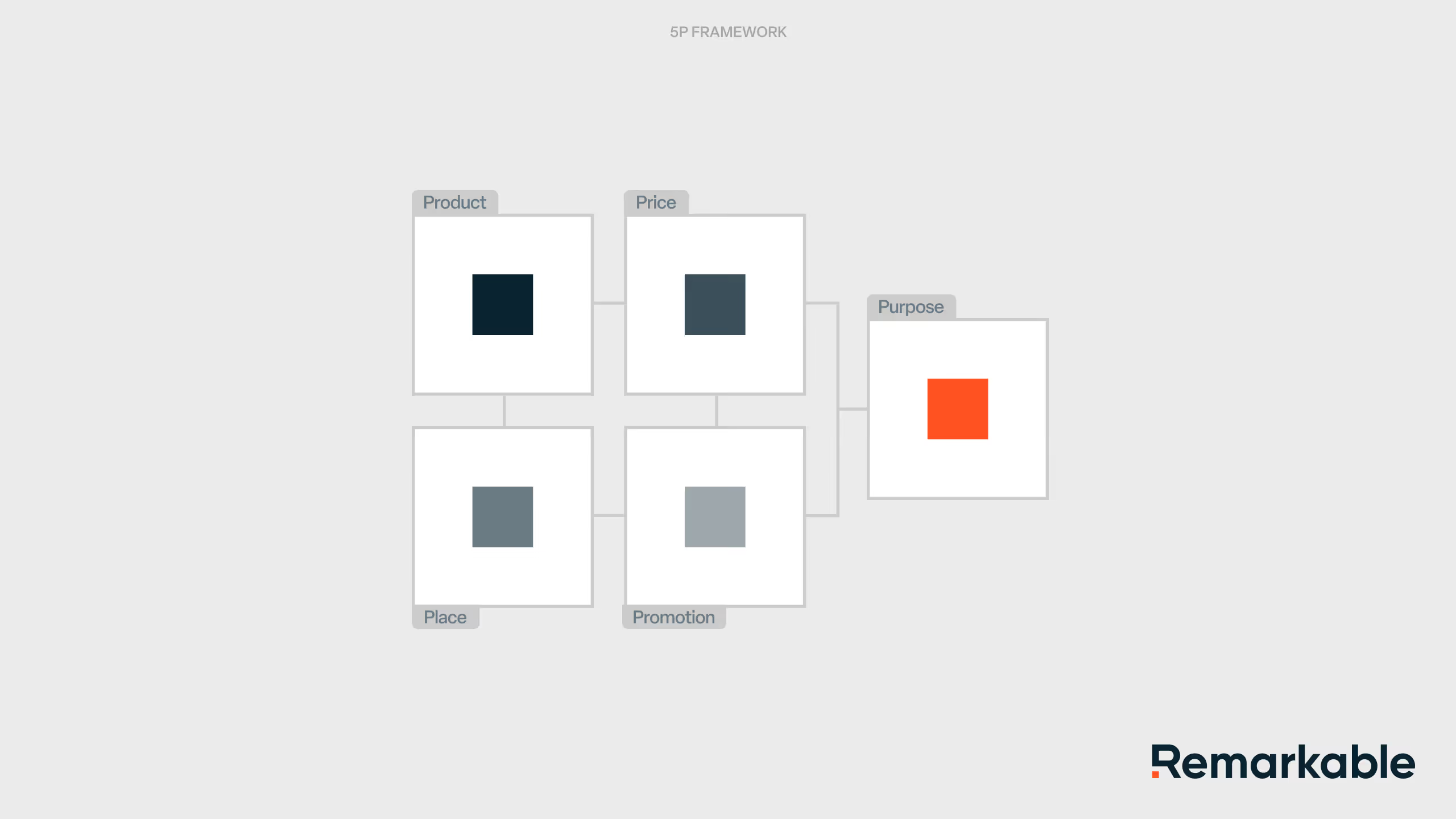
Philip Kotler calls it the fifth P. He is not wrong. But there is a sequence problem that his framework does not fully address.
Purpose has become the most cited and most mishandled concept in brand strategy. Not because the idea is flawed, but because most organisations approach it backwards. They start with the campaign and then look for the foundation. That is precisely where things go wrong.
Purpose is not a product feature with a story attached
Here is a distinction worth making explicitly. Reformulating your coffee capsules into a pen is a product initiative. A creative and possibly a well-intentioned one. But it is not purpose.
Purpose is what happens when a company decides to use its position in a sector to fundamentally challenge the way that sector operates. It is the decision to take on a role, not just a responsibility. To wake up an industry, not merely manage its waste.
The difference is not one of degree. It is one of direction. A product feature can be recycled, iterated, and eventually abandoned. A genuine purpose shapes the decisions a company makes before any product exists, and long after any single campaign has run.
That distinction matters because the confusion between the two is exactly where credibility breaks down. When a brand attaches a purpose narrative to an initiative that sits at the periphery of its core business, stakeholders notice the gap. Not immediately, perhaps. But consistently, over time, the distance between what a brand claims to stand for and what it actually does becomes the dominant story.
The three questions purpose has to answer first
Before purpose becomes a communication asset, it must answer three questions that belong in the boardroom, not the campaign brief.
Why does someone choose to work here? Talent does not move on salary alone. People choose organisations whose reason for existing resonates with their own. When a company cannot articulate that reason clearly, it loses the conversation to companies that can.
When a new product is on the table, what decides? Profitability is a necessary condition, not a sufficient one. A company with genuine purpose uses that purpose as a strategic filter. Not every margin-positive opportunity belongs in the portfolio. The question is not only whether we can sell this, but whether this is something we should build, given who we are and the role we want to play.
Why would someone invest in this company? An increasing share of capital follows organisations with a clear reason for existing. Not out of idealism, but because purpose signals long-term orientation and strategic coherence. It reduces a specific kind of risk: the risk that an organisation loses its direction the moment the market shifts.
These are not marketing questions. They demand a strategic answer built at brand level.
The why precedes everything
Purpose lives in the why of a brand. Not in the tagline, not in the sustainability report, not in a reactive campaign built around a cultural crisis. It lives in the answer to a question most organisations have never formally asked themselves with enough precision to act on: why does this brand exist, beyond commercial growth?
That question shapes mission, vision, and the DNA of the brand. When brand strategy is built with purpose at its core, the DNA becomes more than a document. It becomes the framework against which every decision, whether around products, partnerships, or communication, can be tested.
This is what separates purpose-driven brands from purpose-adjacent ones. The communication reflects the foundation. It does not create it.
Purpose as a brand asset
Purpose is not a value. It is a brand asset. And like any asset, it has to be built carefully, maintained consistently, and deployed with discipline.
The risk is not insincerity. Most organisations that engage in what Kotler calls purpose-washing are not being deliberately dishonest. The risk is sequencing. They reach for purpose as a communication tool before they have done the strategic work of defining what role they genuinely want to play in their sector. The result is a campaign that borrows the language of purpose without the authority to use it.
Hooking onto a crisis, a cultural moment, or a trending cause without a structural connection to your brand's actual position is not activation. It is exposure. It invites scrutiny the brand cannot withstand.
Purpose used correctly is one of the most powerful instruments in brand development. Not because it persuades, but because it orients. When the foundation is solid, communication knows exactly what it is serving. And when the moment is right, it can activate with authority: a genuine opportunity to take a position, a product launch that embodies what the brand stands for, a cultural conversation the brand has actually earned the right to join.
That authority cannot be borrowed. It has to be built.
What boards need to own
The shift Kotler and Sarkar describe is real. But the implication for organisations is not a new brief for the marketing team. It is a harder conversation in the boardroom: what role does this company actually want to play in its sector? What would it mean to genuinely pursue that role, in product decisions, in talent choices, in partnerships, in what we refuse to do?
That conversation produces something durable. A purpose formulation precise enough to be tested against every major decision the organisation makes. A brand DNA that gives communication a real foundation to work from rather than a theme to perform around.
Purpose is a strategic decision before it is a communication decision. Organisations that reverse that order are not building purpose. They are borrowing it.
And borrowed purpose has a way of being returned, at the worst possible moment.