The most dangerous AI name often sounds good

A brand name rarely becomes dangerous because it sounds bad.
Bad names usually do not reach the meeting room. They feel forced, generic or immediately unusable. The real risk lies in names that sound professional enough to be trusted too quickly.
That risk has grown now that AI is becoming a natural part of name development. ChatGPT can help generate brand names, but it does not replace a professional naming process. A usable brand name must fit strategically, work linguistically and be legally available and defensible.
For companies that need a new product name, platform name or corporate name quickly, AI can feel like a breakthrough. In minutes, it produces directions, associations and rational explanations. But a name that sounds good is not necessarily a name an organisation can safely use, protect or grow internationally.
ChatGPT helps with name creation, not name choice
AI has clearly accelerated the creative part of naming. A good prompt can help move beyond the most obvious ideas, open new word fields, suggest unexpected combinations and enrich a shortlist with directions that may not appear in a traditional brainstorm.
That is valuable. Naming benefits from volume, variation and exploration, especially in the early phase where choosing too quickly often leads to safe, descriptive or weakly protectable names.
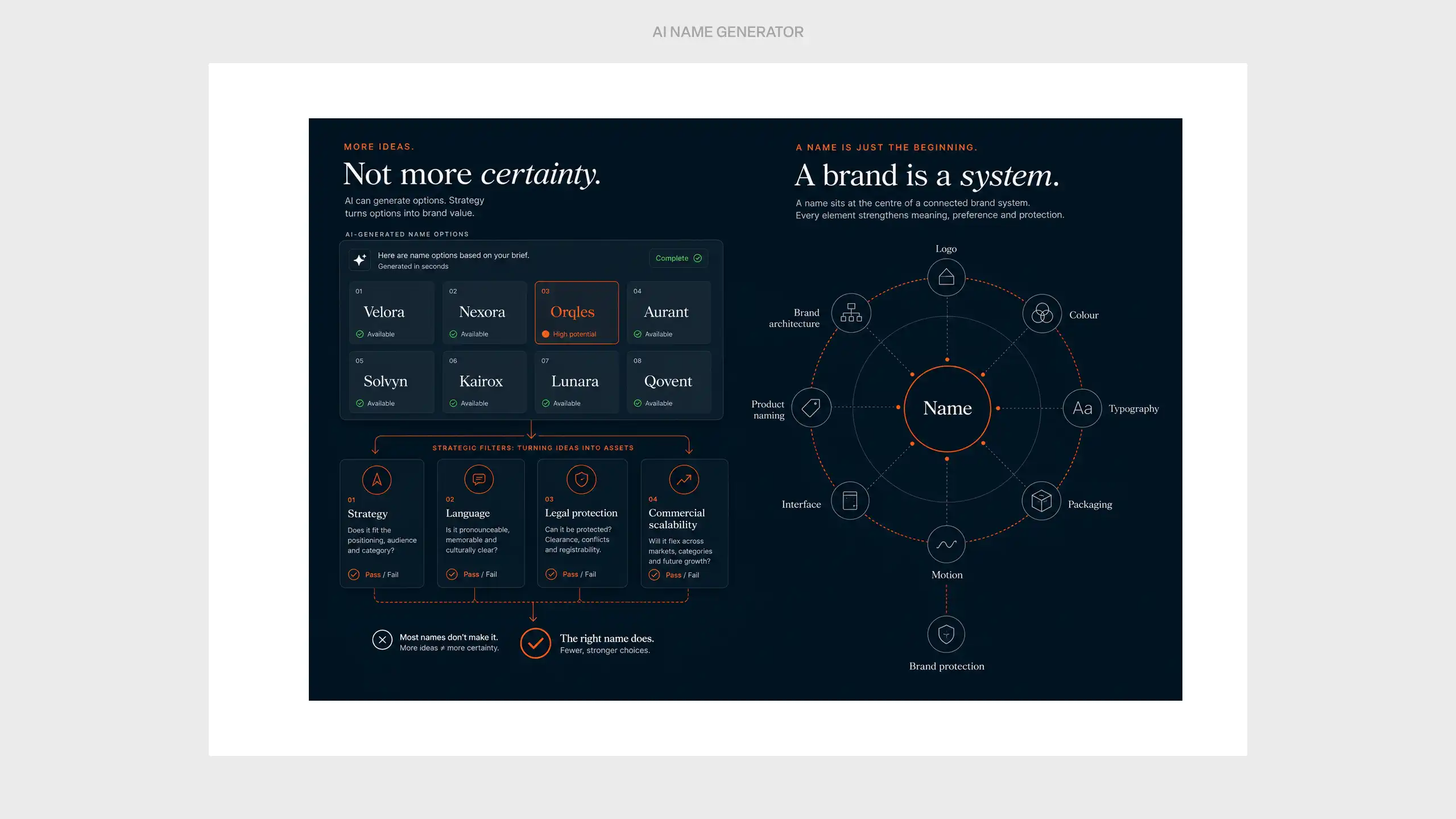
But naming is not a competition in generating as many ideas as possible. A brand name is not just a clever concept. It is a strategic choice with legal, linguistic and commercial consequences. A name must fit the positioning of today, but also the growth of tomorrow. It must be understandable in the markets where the brand wants to move. It must be distinctive enough to build meaning. And it must be legally available and defensible in the categories where the company operates.
AI can support creation. It does not replace the judgement that follows.
An AI name that sounded good enough to believe
We tested this with a fictional AI and SaaS scale-up. The brief was deliberately realistic: a company active in supply chain optimisation, with international ambitions in Europe and the United States. The name had to be scalable, non-descriptive and credible for a B2B audience.
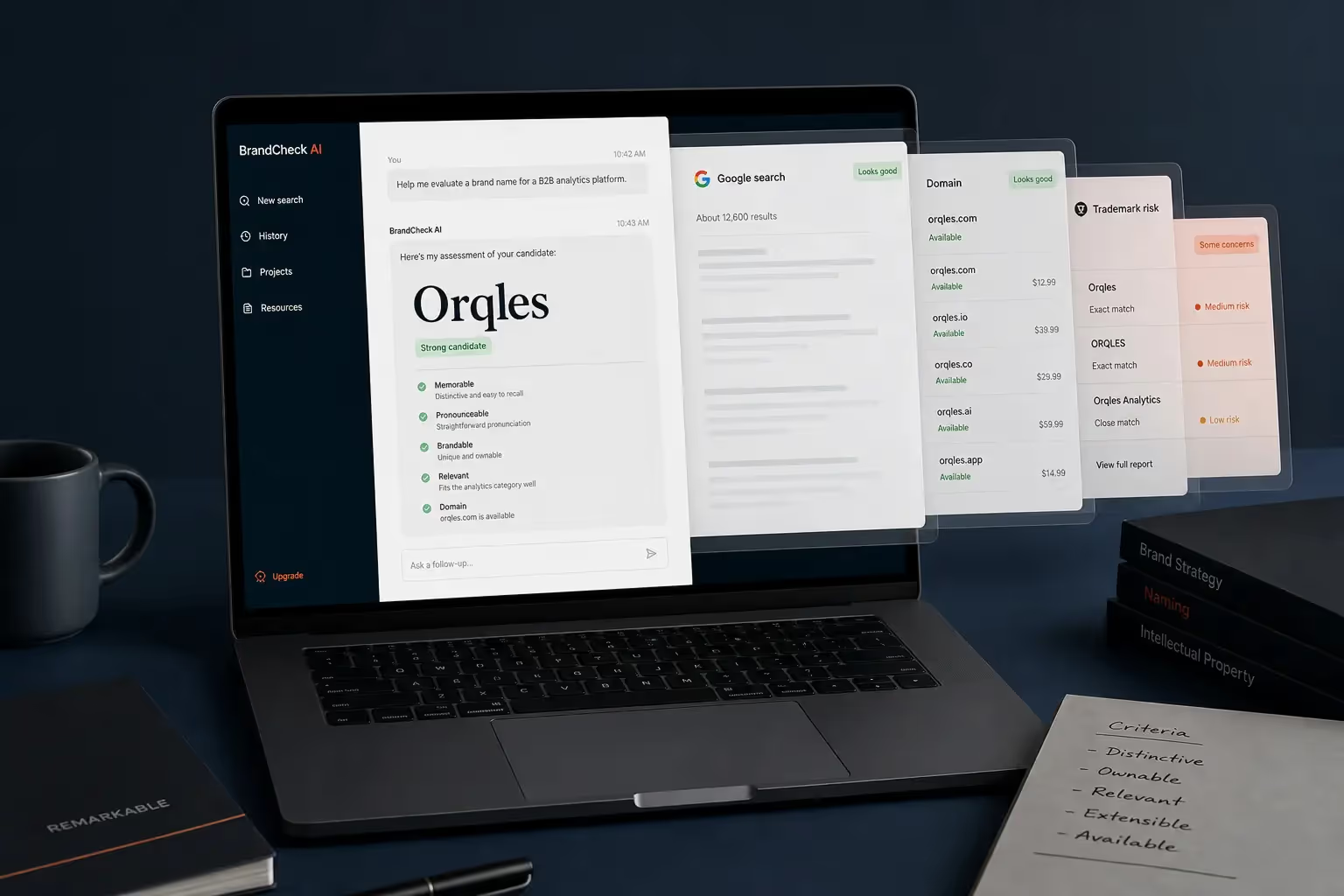
ChatGPT proposed several names. Each one came with a rational explanation. After a few iterations, one candidate emerged: Orqles. The rationale sounded logical. “Orq” referred to orchestration. The name suggested intelligent layers that connect and synchronise complex supply chain decisions. Short, abstract, technological and international enough.
At first glance, there was little wrong with it. A first Google check did not reveal a clear direct competitor. The domain name seemed available. A quick trademark register search did not show an identical mark. For many organisations, this is the moment when a name starts moving from option to decision.
A domain is registered. A first logo appears. The name enters a pitch deck. Internal stakeholders get used to it. The name gains momentum. And once a name gains momentum, it becomes harder to let go.
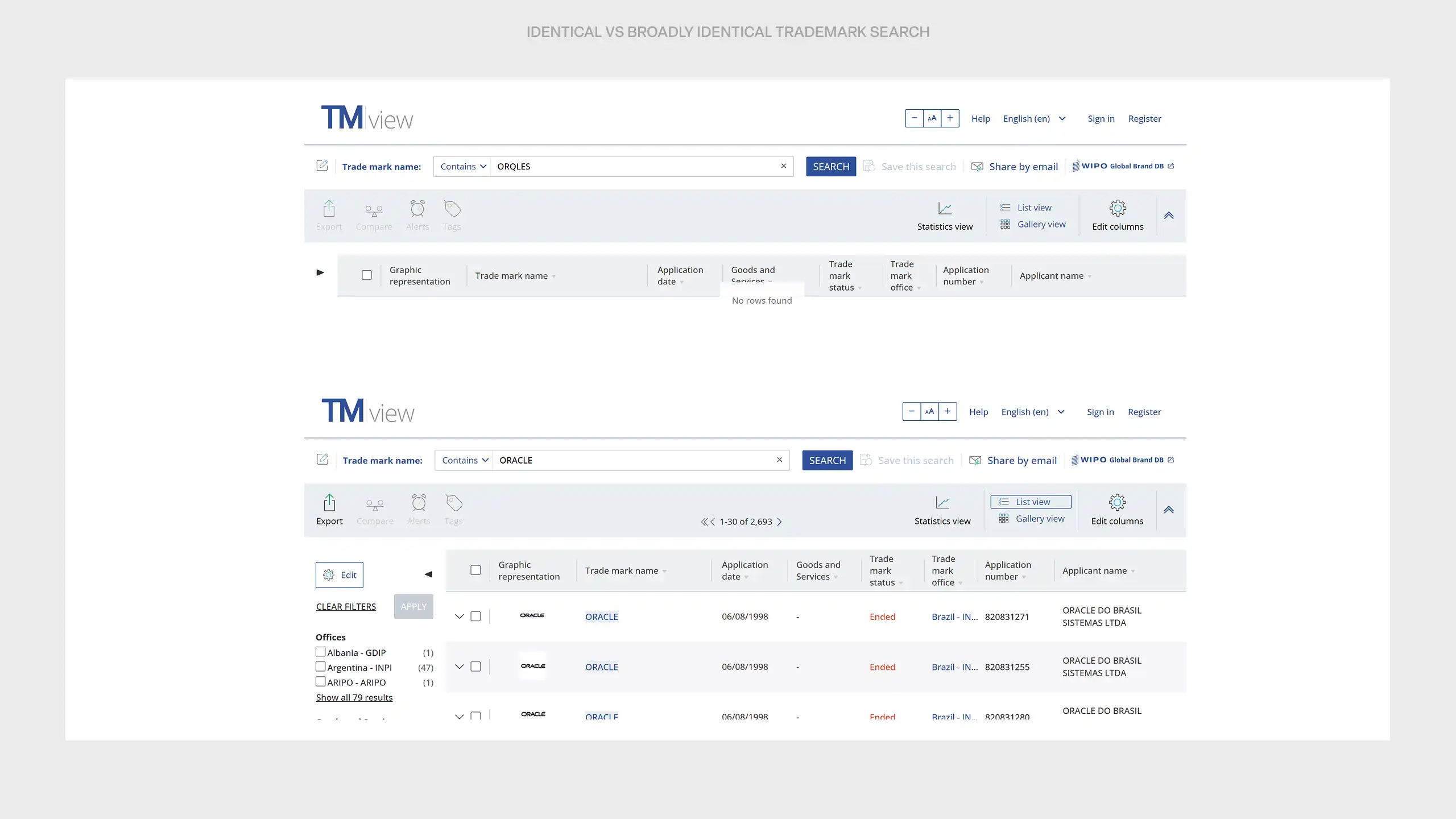
Why a first brand name check is not a clearance search
A first check is useful, but it is not the same as a clearance search. Google does not show the full legal risk field. A domain checker says nothing about earlier trademark rights. An identical search in a trademark register says little about phonetically or visually similar marks that may appear through broader searches. And a name that sounds neutral in one language may create unwanted associations in another context.
That became clear with Orqles. In a real search environment, unwanted associations appeared. Search behaviour moved towards words and results that would be undesirable for a B2B software company. Not every result is harmful, but the first digital context is no longer fully controlled by the brand itself.
A strongly similar name also appeared in an adjacent software context. That does not automatically make Orqles legally impossible. But for an AI and SaaS company, it is a relevant signal. The difference between two names may look small on paper, yet weigh heavily when the visual or phonetic overall impression is close.
The issue was not one obvious red flag, but the accumulation of signals. That is often what naming risk looks like: not an absolute blockage, but a set of indications showing that a name is less free than it first appeared.
Naming requires strategy, language and protection
A strong brand name is not created by ticking three boxes. Yet the process is often organised that way: first creative, then linguistic, and only at the end legal. That may look efficient, but it creates the exact risk that a name already feels chosen before it has been properly assessed.
Strategy, language and legal protection influence each other from the start. A name can be strategically strong but legally weak. A name can seem legally possible but be linguistically problematic. A name can work for one product but block future brand architecture.
That is why we approach name development as an integrated process. Strategically, the name must be able to carry the positioning, growth ambition and future portfolio. Linguistically, it must work in sound, pronunciation, connotation and digital search context. Legally, it must be possible to register, protect and defend within the relevant classes and regions.
A brand name must not only sound good. It must be usable.
A brand is more than a name and a logo
The same shift is visible in brand development more broadly. A brand is still too often reduced to a name and a logo. Today, that view is too narrow.
Recognition increasingly emerges from systems: word marks, figurative marks, colour use, typography, packaging, icons, motion, digital interfaces, product shapes, patterns and tone of voice. The way these elements create a recognisable overall impression determines how a brand is remembered and distinguished.
That also has legal consequences. Not every element is automatically protectable. Not every element deserves registration. But the question must be asked, especially when a brand invests in a distinctive visual or verbal world that competitors may later imitate, approach or dilute.
AI accelerates exploration here too. It can generate variations, evoke visual directions and simulate styles more quickly. But it does not determine which elements are strategically ownable, which can become legally defensible and which carry long-term commercial value.
The risk lies in names that persuade
The biggest weakness of AI naming is not that AI creates bad names, but that it can rationalise mediocre or risky names convincingly. It gives a name a story, links sounds to meanings and explains why something appears strategically right. As a result, the output feels substantiated, even when the real assessment has not yet taken place.
That makes AI useful in the process, but risky as a shortcut. AI can support research, inspiration, word fields, variations and presentations. But it does not take responsibility for the name that eventually appears on a product, pitch deck, trademark filing or international launch.
Orqles shows where the risk lies. Not in a name that feels immediately wrong, but in a name that sounds professional enough to be trusted too early.
AI makes it easier to invent a name. Not to choose a good one.
Because a good brand name is not the name that sounds best. It is the name that works strategically, linguistically and legally.